


SCHINKEL IRON VASE
Couldn't load pickup availability
A Neo-Classical Cast-Iron Amphora Urn Attributed to Karl Friedrich Schinkel (1781 – 1841)
Manufactured by Sayner Hütte the Royal Prussian Iron Foundries
German, circa 1820’s
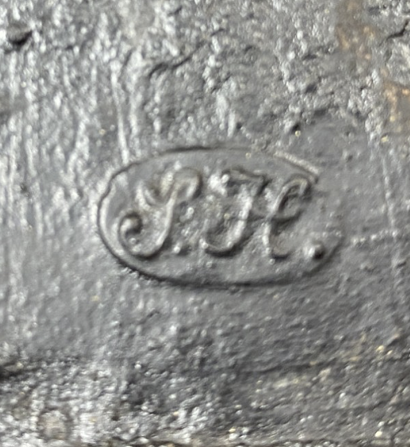
Stamped in the cast: ‘SH’
Dimensions - 32 cm high
Share

Schinkel used cast iron not only for its strength and durability but also for its patriotic symbolism in public and domestic settings. Through state-backed commissions, he tied cast-iron manufacturing to national identity, making the Prussian iron industry a symbol of patriotism. Its matte black surface is blackened with a liquid patina, a technique pioneered at the Royal Ironworks suited memorials, tombs, and medals—especially the Iron Cross, Prussia’s highest honour. Designed by Schinkel in 1813 to commemorate soldiers who fought Napoleon; the Iron Cross echoed the medieval German knightly emblem and became a symbol of wartime sacrifice.
In 1826, during his visit to Great Britain, Schinkel was captivated by English advances in castiron engineering - especially the bridges of John Rennie and Thomas Telford. Schinkel also studied Brunel’s Thames Tunnel under construction, noting cast iron’s use in docks, warehouses, factories, railways, and engines. Inspired by John Nash’s exotic cast-iron interiors at Brighton’s Royal Pavilion, particularly the bamboo-like stair rails, Schinkel began blending historical styles with functional and decorative iron elements in his own designs.
Vorbilder – a multi-volume series of illustrated design plates published in Berlin between 1821 and 1837 under the direction of Karl Friedrich Schinkel, with contributions from artists such as Peter Beuth, Schinkel’s collaborator and head of the Prussian Department of Commerce and Industry - played a major role in shaping the design of decorative objects created for princely and private residences. The publication illustrated designs for vases of all sizes, such as replicas of the Warwick Vase of 1828, one of the most popular products of the Royal Ironworks of Berlin. The cast-iron version was modelled after the antique marble original in Warwick Castle in England that Schinkel might have seen in the summer of 1826. The vases were manufactured in a variety of sizes, including one large enough to be used in Schloss Glienicke as a garden ornament. Another well-known vase, cast in iron, was a copy of the British Museum’s large marble Bacchanal krater vase (Roman, 138–161 B.C.). Since Schinkel’s design for the Vorbilder were meant to be used as stylistic guides, not specific blueprints, there were many variations in the finished products.
