


A Young Woman Shucking Oysters
Couldn't load pickup availability
French School, late 18th / early 19th century
Oil on canvas, in giltwood frame
Dimensions: 20cm x 18cm framed
Half-length and turned to engage us directly, the young woman with a shucking knife in one hand, an oyster cradled in the other, wears a white linen cap, a loosely crossed white fichu, and a blue apron.
Share

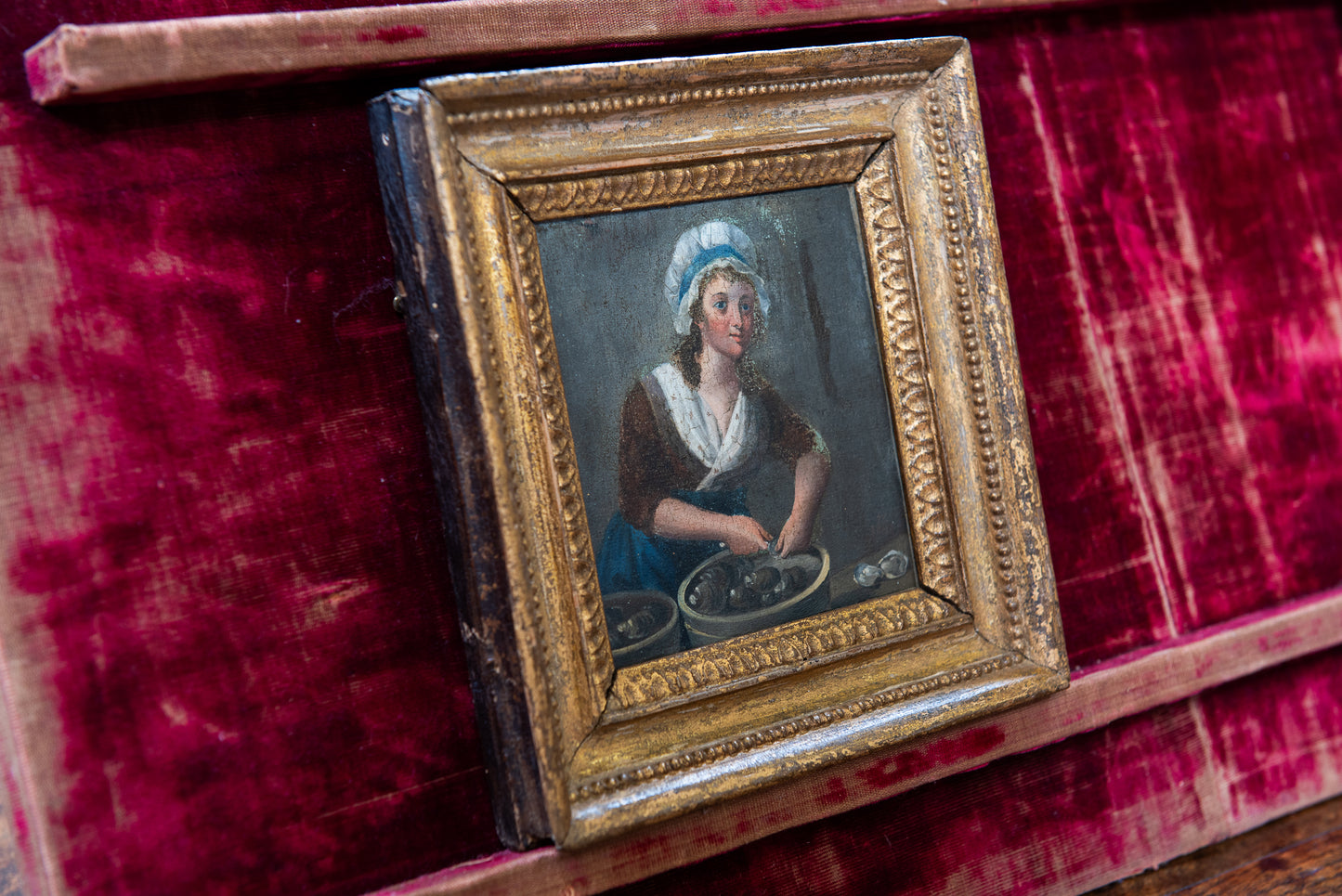
The subject — a single oyster-girl who breaks off to meet the viewer's eye — belongs to the 18th-century "fancy picture," a term coined in 1737 by the connoisseur George Vertue for the gently contrived, sentimental genre scenes then in fashion. Such images owed their reach to a booming print market: Philippe Mercier's celebrated Oyster Girl was engraved twice by Richard Houston, first as 'The Fair Oysterinda' and then as 'Native Meltons', each plate carrying a verse that leaves little doubt the wares on offer were not only the oysters —
"The oysters good — the Nymph so fair! / Who would not wish to taste her Ware? / No need has she aloud to Cry 'em / Since all who see her Face must buy 'em."
The conceit was an old one, taken from the European tradition of street-vendor "Cries" — Marcellus Laroon's 'Cryes of the City of London' or 17th-century Dutch genre painting, in which the preparing of food so often stood for the stirring of other appetites.
Jan Steen's flirtatious Girl Eating Oysters, in the Mauritshuis, is a prime example. Indeed, French 18th-century engravings after such Dutch pictures often carried the same teasing captions: a print after Gerard Dou's Girl Chopping Onions hints that the girl is rather more appetising than the meal she prepares.
The picture is unmistakably French in feeling; cool tones and the tender, faintly wistful cast of the girl's features place it in the orbit of Jean-Baptiste Greuze, whose expressive heads of young women were the most imitated of the age and passed, through engraving, into a whole school of followers. Rather than a copy after any single famous composition, this is best understood as a French painter's variation on this much-loved type.
